Indivd Insights
What fitting room data reveals about store performance
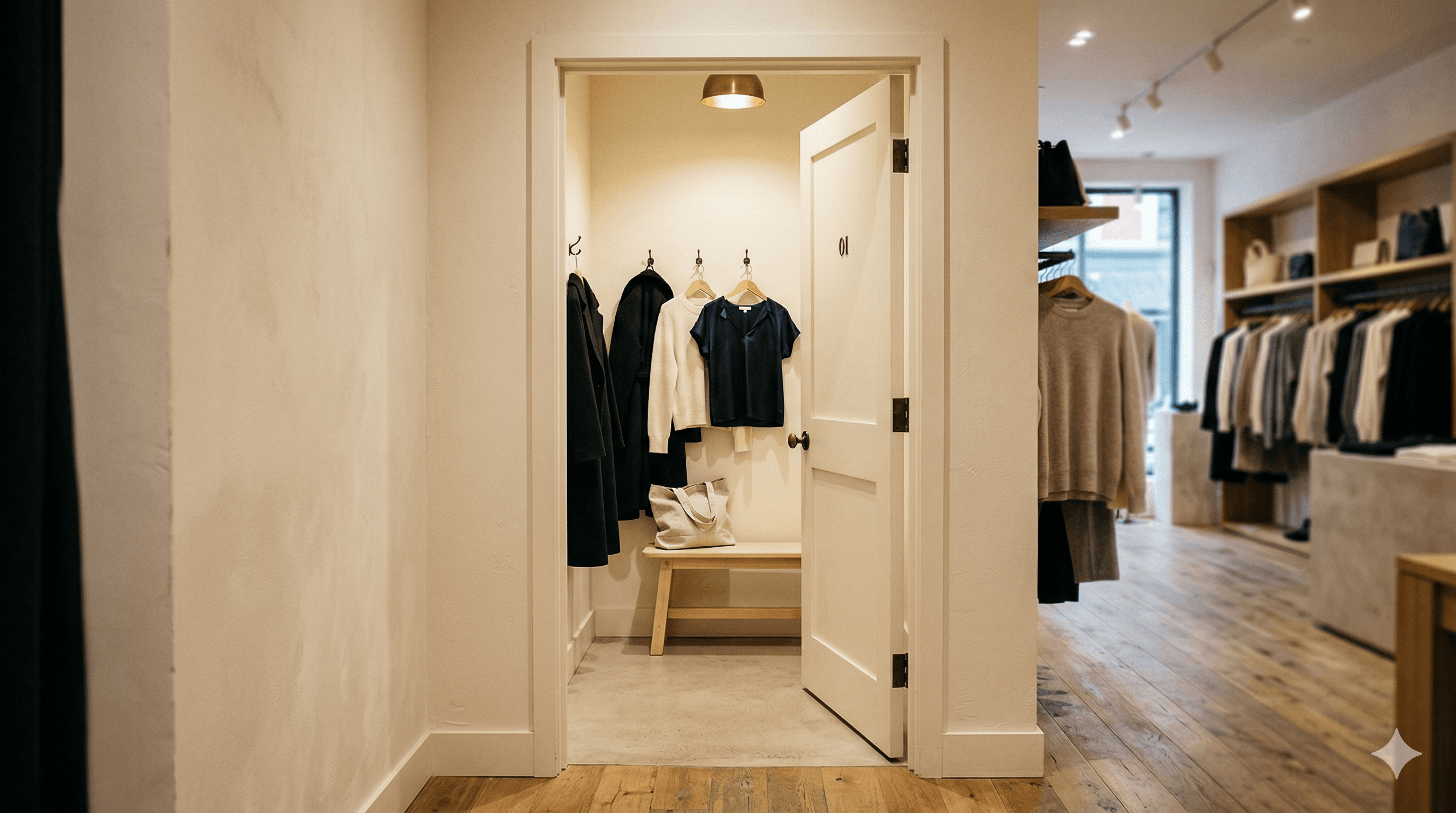
That gap, between what happened on the sales floor and what happened behind the fitting room door, is one of the most significant blind spots in physical retail. It is also one of the most commercially costly.
Fitting rooms are not a support function. They are the decision point. A visitor who tries something on has moved from browsing to considering. The research literature is consistent on this: customers who use fitting rooms convert at dramatically higher rates than those who browse the sales floor alone. Yet for most retailers, the fitting room remains operationally invisible. It is staffed by intuition, managed by exception, and almost never measured with the same rigor applied to entrances, tills, or display windows.
That is beginning to change.
The data gap at the heart of the store
For decades, the primary lens through which retailers understood store performance was footfall: how many people came in. That number matters, but it is an input metric, not an outcome one. What retailers actually need to know is what happened to those people once they were inside, and whether the store gave them the conditions to decide to buy.
The fitting room sits at the center of that decision. And yet the operational questions that should govern fitting room strategy, when is it under the most pressure, which zones in the store are feeding it, and at what hours does it convert visitors most effectively, have historically been unanswerable without significant manual effort.
The result is a management approach built on questions that are almost never answered with data: how many associates should be assigned here, at what hours, and where do recovered garments belong when the fitting room empties? Without visibility into when the fitting room is under pressure and which parts of the store are feeding it, those decisions default to intuition and shift templates.
Academic research has established just how consequential this gap is. A study published in Manufacturing and Service Operations Management found that fitting room traffic follows an inverted-U relationship with sales: beyond a certain threshold, more visitors in the fitting room begins to suppress the store's overall sales performance. The mechanism is something the researchers called phantom stockouts, garments that are physically present in the store but effectively unavailable for purchase because they are occupying a fitting room cubicle rather than a rack.
Source: Lee, Kesavan and Deshpande (2021), Manufacturing and Service Operations Management
That is a meaningful return on a simple intervention. But it requires knowing when and where to intervene.
What the data actually reveals
When a retailer gains access to hourly zone-level analytics for the fitting room, the patterns that emerge are rarely what managers would have guessed.
In a recent analysis of a leading global apparel retailer covering several weeks of trading, a clear and consistent picture emerged. The fitting room was above the store's own crowdedness threshold during 98% of all trading hours. Not during peak hours, not on Saturdays only, but as a structural condition across the entire week. This was not a peak day problem. It was the baseline.
The time of day told a sharper story. The fitting room converted engaged visitors at 20% during the final two hours of trading, and at just 6% during the midday window. The same pattern repeated across every week in the data. The best and worst windows were entirely predictable.
And the single most commercially important slot in the week was Saturday at 16:00. Not the busiest hour. Not the highest crowdedness. Just the moment when enough visitors were present and the conditions were right for them to reach the tills.
The question worth asking is not just "when does the fitting room perform best?" but "when does it produce the most tills visits per hour?" Those are different questions, and they sometimes point to different hours.
The section nobody talks about
There is a second pattern in fitting room data that almost no retailer is tracking.
When you map which sections of the store are feeding the fitting room, the distribution is rarely proportional to floor space or display investment. In the analysis, the Men's section sent a smaller share of total fitting room visitors than Women's, but Men's browsers were proportionally far more likely to make the trip. Nearly twice as likely, in fact.
That kind of information reframes the fitting room not just as a zone to be managed but as a lens on how different parts of the store are working. A section with high fitting room conversion is a section where visitors are engaged enough to try things on. A section with low fitting room conversion may have a display problem, a product problem, or a staffing problem, and the fitting room data is the diagnostic signal.
This is precisely the kind of insight that does not show up in footfall data, and does not show up in sales data either. It sits in the middle, in the movement of people between zones, and it has been invisible to most retailers until recently.
From observation to action
The gap between knowing and doing something about it is where most analytics investments stall. Retailers are very good at accumulating dashboards, and much worse at turning what those dashboards show into a decision taken on a Tuesday morning. The promise of better store analytics is not more data. It is fewer hours spent looking for the problem and more time spent solving it.
For fitting rooms, the leap from observation to action is shorter than it might appear. The pattern is consistent and predictable enough that the intervention is straightforward: deploy a fitting room attendant during the hours where engaged visitors are present but conversion is weakest. Then measure what happens.
The test design does not need to be complicated. Pick two comparable weekdays each week. Run one with an attendant during the low-converting midday window, one without. Let the zone-level data capture the result automatically. After four weeks, the comparison tells you whether the intervention is worth scaling, and by how much.
This is what the shift from dashboards to decisions looks like in practice. Not a reorganisation, not a technology overhaul, not a strategy offsite. A four-week test with a clear measurement framework and a decision at the end of it.
The next step is simpler still. A store manager should not need to find the pattern themselves. They should arrive each morning to a clear recommendation: where to focus today, and why. The data already knows. The job is to act on it.