
Indivd
•
•
Intro
Four home improvement stores in Northern Europe used the same overhead 3D counters and produced four different errors, ranging from a 4.4% overcount to a 19.2% undercount.
Four home improvement stores in Northern Europe compared their installed overhead 3D people counters with Indivd over the same ten days, from 28 April to 7 May 2026.
The installed counters produced different errors at every store. Daily results ranged from a 4.4% overcount to a 19.2% undercount.
Across the four locations, Indivd counted 60,534 visitors entering. The installed counters reported 56,544, a shortfall of 3,990 visitors. Indivd’s reference count at every store was verified at a minimum of 98.08% absolute accuracy.
A spring fortnight at four home improvement stores in Northern Europe. Each store had the same type of technology above its doors: an overhead 3D people counter that had been reporting footfall for years.
For ten days, a verified second count ran beside every installed counter.
No two stores were wrong in the same way.
The stores
The same counting technology produced four different errors
A retail chain standardises its counting hardware with the expectation that one technology will behave consistently across its stores. That consistency matters because the chain uses visitor data to compare locations.
Which store converts best? Where should weekend staff be placed? Is a slow spring caused by the local market or by the store itself?
The comparison showed that using the same hardware did not produce the same counting behaviour.
At one store, the installed counter undercounted every day, with daily errors ranging from 11.7% to 19.2%.
At another, the error changed direction during the ten days, ranging from a 4.4% overcount to a 14.8% undercount.
The remaining two counters stayed within single-digit undercounts. Their daily errors ranged from 0.5% to 6.7% at one store and from 0.9% to 6.4% at the other.
The sensors were the same. The four stores produced four different error patterns.
Nothing downstream automatically reconciles a door count. A till has a cash drawer to answer to. A counter above the entrance has no equivalent check, so whatever it reports becomes the visitor number used to compare stores.
The check
Ten days, side by side, at four stores
From 28 April to 7 May 2026, the installed counters’ daily entry totals were compared with Indivd’s totals at all four stores.
Across the ten days:
Indivd counted 60,534 visitors entering
The installed counters reported 56,544 visitors
The aggregate difference was 3,990 visitors
Daily errors ranged from a 4.4% overcount to a 19.2% undercount
The aggregate difference does not show the complete problem. At one store, the installed counter moved between overcounting and undercounting. Errors in opposite directions partly cancelled when combined into a net total.
Each Indivd reference was verified against an independent count of the same hours. Every store achieved at least 98.08% absolute accuracy, reported at a 99.99% confidence level.
The daily results are the central finding. Across the four stores, the installed-counter errors spanned 23.6 percentage points.
A counter that produced the same error every day could potentially be adjusted using a correction factor. These counters did not maintain a consistent error during the ten days. At one store, the error even changed direction, leaving a correction factor with no reliable direction to follow.
DEFINITION
Absolute accuracy is 100% minus the absolute error rate.
Undercounts and overcounts are both errors. A missed entry, a missed exit, and a person counted even though they did not cross are each counted in full. Errors in opposite directions cannot cancel one another.
What the number carries
Inconsistent counting errors can distort every store comparison
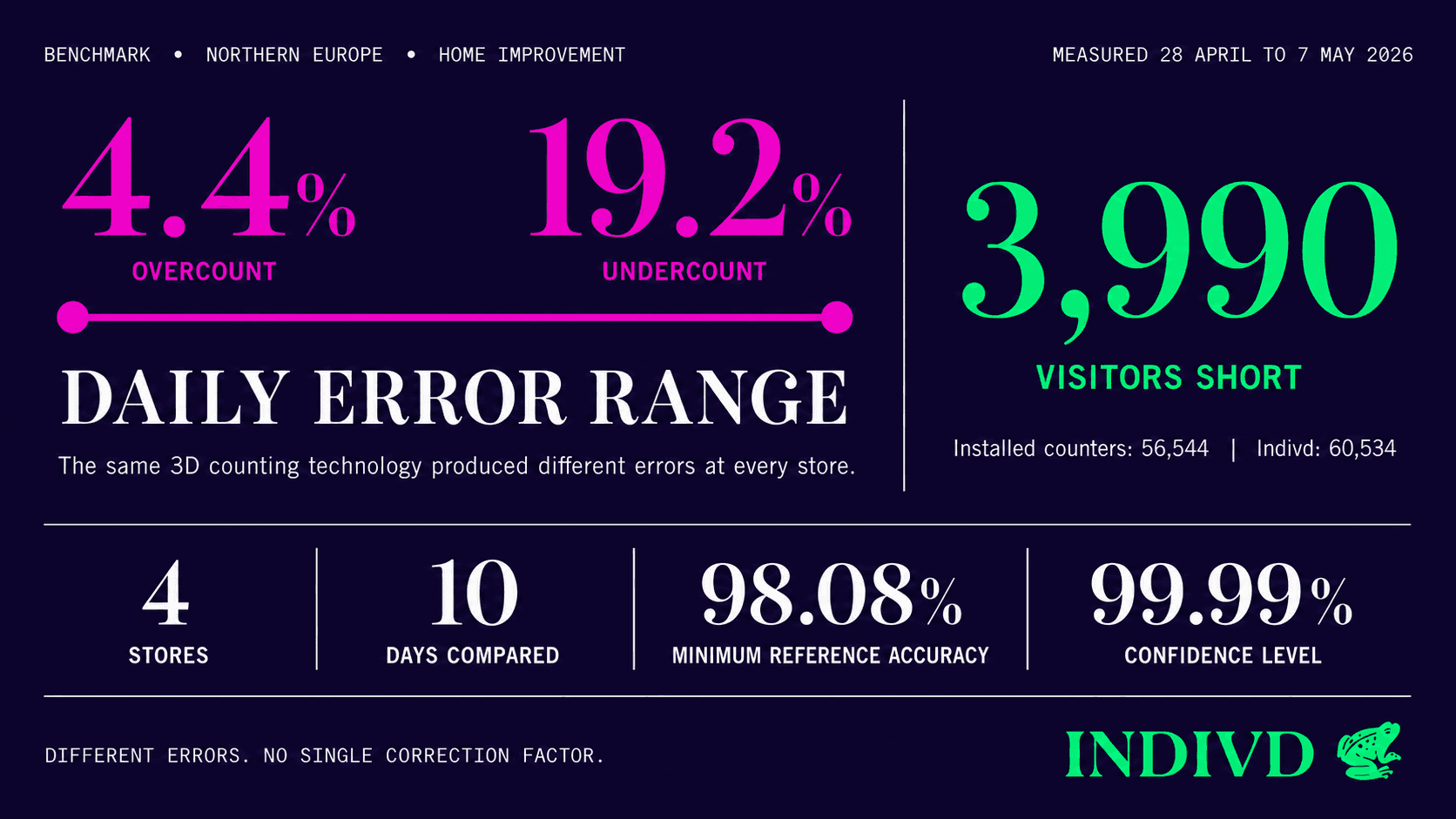
Measured from 28 April to 7 May 2026 at four home improvement stores in Northern Europe: installed overhead 3D people counters produced different daily errors at every location.
The daily difference ranged from a 4.4% overcount to a 19.2% undercount. The installed counters reported 56,544 visitors against Indivd’s 60,534, an aggregate shortfall of 3,990 visitors.
Each Indivd reference achieved at least 98.08% absolute accuracy against an independent count of the same hours, reported at a 99.99% confidence level.
A stable error at one store can be treated as a local measurement problem. Different and changing errors across four stores affect the retailer’s ability to compare those stores.
Conversion, sales per visitor, staffing decisions, and investment cases all depend on the visitor count. If each store’s counter is wrong by a different amount, performance rankings can be influenced by the counting hardware rather than by the stores themselves.
There is no single correction factor for the four locations. Even a separate factor for each store would be unreliable when the size of the daily error changes and, at one location, moves between overcounting and undercounting.
Entry totals do not explain visitor behaviour
The comparison also showed what happens after a visitor enters.
Of the 60,534 visitors counted by Indivd:
12,412 left within 3 minutes
32,940 browsed
15,182 stayed for 10 to 45 minutes
The composition of traffic varied substantially by store. The share of entrants classified as potential customers ranged from 13% to 47%. The share who left within 3 minutes ranged from 3% to 44%.
Two stores can report the same footfall while receiving very different types of visits. An entry-only counter cannot show that difference, regardless of how accurately it counts entrances.
This is not only an accuracy issue. It is also a difference in what the counting system can measure.
In a separate engagement, KPMG audited Indivd’s counting accuracy at a major retailer’s store against manual ground truth. Every camera tested came within 1.17%, the strongest result of any system included in that audit.
What the retailer gains is a consistent denominator for comparing its stores. The next question is not simply which store attracted the most visitors, but which store created the most value from the visitors it attracted.
FAQ
Why is my footfall data wrong?
Usually because the counter has never been checked against anything. A visitor count has no natural second source the way a till total has a cash drawer, so whatever the counter reports becomes the number the business accepts. Across these four stores, installed counters were undercounting by up to 19.2% a day.
How do you audit an existing people counting system?
Run a second, independently verified count over the same hours and compare daily totals rather than period totals. Period totals hide the problem, because overcounts and undercounts partly cancel when they are added together.
Do 3D people counters produce consistent results across stores?
Not in this comparison. All four stores used the same type of overhead 3D counter, and their daily errors differed in both size and direction, ranging from a 4.4% overcount to a 19.2% undercount over the same ten days.
Can a correction factor fix an inaccurate footfall counter?
Only when the error is stable and predictable. It has nothing reliable to follow when the size of the error changes day to day, and nothing at all to follow when the error moves between overcounting and undercounting, which happened at one of these four stores.
How accurate are people counters in DIY and home improvement retail?
Entrances built for trolleys and timber, bulky goods that obscure the body, and seasonal garden entrances all make this a difficult format to count. In this comparison, installed 3D counters reported 56,544 visitors where the verified reference counted 60,534.
Can a third party verify Indivd's counting accuracy?
Yes. The customer decides where, when, and how much is tested, can run the check without Indivd present, and can put the same test in anyone else's hands.