
Indivd
•
•
Intro
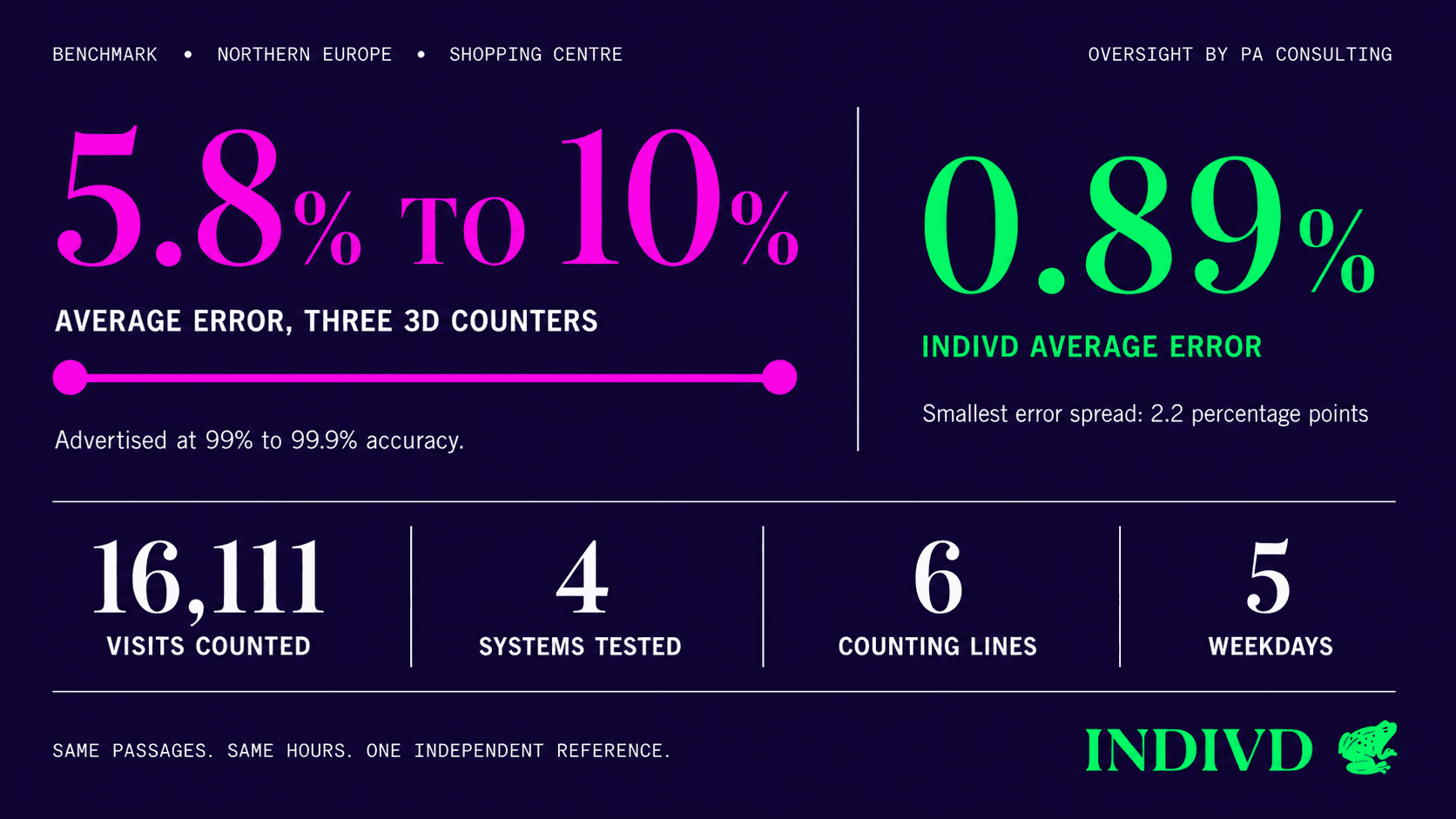
Four people counting systems ran side by side at a shopping centre in Northern Europe, overseen by PA Consulting. Three 3D counters averaged 5.8% to 10% error despite being adversited at 99% accuracy.
Key findings
The three 3D people counters advertise accuracy of at least 99 percent. In this benchmark, their average errors ranged from 5.8 to 10 percent.
Their errors changed between hours and counting lines. The measured spreads ranged from 5.0 to 70 percentage points, compared with 2.2 points for Indivd.
All four systems counted the same passages during the same hours. Each vendor configured and approved its own installation before the comparison began.
An error that changes between hours or entrances cannot be corrected reliably with one fixed adjustment.
People counting accuracy depends on the complete deployment, including installation, configuration and verification under real conditions.
For five weekdays, visitors crossing three passages at a shopping centre in Northern Europe were counted by four systems and by an independent count of the same hours.
The results did not match the advertised figures.
The claim
Advertised accuracy without a comparable measurement
People counters produce figures that retailers and shopping centres use every day. Those figures inform conversion rates, staffing plans, performance comparisons and commercial reporting.
Unlike a till total, a visitor count has no natural second source. If it is not checked independently, the number reported by the counter becomes the number the business accepts.
The three 3D people counters in this study advertise accuracy of between 99 and 99.9 percent. Those claims do not show how performance changes between entrances, hours or physical conditions.
This benchmark placed an independent count beside each system.
The test
Four systems, the same passages and the same hours
Three passages of a live shopping centre carried all four systems at once: a wide entrance, a three-lane intersection, and a cafe aisle where a low ceiling meets the widest passage and hanging decorations with moving parts sat partly in one camera's view. Nothing was staged and nothing was moved. The passages were equally demanding for every system.
Each vendor supplied, configured and calibrated its own counter, was asked for adjustments before measurement began, and approved its installation and its data before the comparison started; one was granted the calibration period it requested. Indivd makes one of the systems tested, a conflict declared from the outset: the study's location, scope and method were agreed with PA Consulting before it began, and the independent auditor oversaw the methodology, the analysis and the results.
The ground truth was an independent count of the same hours, produced the same way as Indivd's regular quality assurance: 16,111 visits counted by hand across all six counting lines, in and out at each passage.
What was measured
Average error and error spread
The benchmark examined two dimensions of people counting performance.
Average error shows how far a system’s count was from the independent count across the test.
Error spread shows how much that error changed between hours and counting lines.
A low average error is valuable, but it is not sufficient on its own. A system can appear accurate overall while producing substantially different errors at different entrances or times.
System |
|
| |||
|---|---|---|---|---|---|
|
|
| |||
|
|
| |||
|
|
| |||
|
|
|
Measured against an independent count of 16,111 visits across six counting lines, the three 3D people counters averaged between 5.8 and 10 percent error. Indivd averaged 0.89 percent error and recorded the smallest spread.
The errors produced by the 3D counters did not remain consistent. One system recorded 1.4 percent error at its best-performing line and 12 percent at its worst. Another ranged from a 57 percent undercount at one passage to a 101 percent overcount at another.
The wide entrance produced the strongest results for most systems. Two of the three 3D counters remained below 2 percent average error there. At the other passages, their errors ranged from 4.5 to 12 percent per line.
Indivd recorded the lowest average error on five of the six counting lines and the smallest spread on five of six. Its highest line-level error was a 3.1 percent undercount at the café aisle, where decorations remained partly within the camera view throughout the test.
MEASUREMENT
This benchmark reports net hourly error, a measure commonly used in the people counting market. Under this measure, undercounts and overcounts within an hour can offset one another.
Indivd’s Quality Assurance reports use absolute accuracy instead. Under absolute accuracy, errors in opposite directions are counted separately and cannot cancel one another.
The two measures should not be compared as though they are identical.
A fixed error may be adjustable. An error that changes between hours and entrances affects every downstream figure differently.
What it means
A moving error bends every figure differently
Visitor counts sit beneath several important retail and property metrics. Conversion divides transactions by visits. Staffing plans use traffic by hour. Shopping centres use visitor figures in performance and commercial discussions.
A stable error can sometimes be incorporated into a baseline. An error that changes between entrances and hours cannot be corrected reliably with one adjustment factor.
This study measured outcomes, not the technical reasons each system produced them. It therefore does not establish that one type of sensor or model will always outperform another.
For a buyer, the question changes shape. Not which accuracy the datasheet states, but how the number was validated at your doors, in your hours, against what second source. Ask it of every vendor. Ask it of this one.
FAQ
What is AI people counting?
AI people counting uses computer vision on standard 2D cameras to detect and count people crossing a defined line, rather than measuring height and shape with a dedicated 3D depth sensor. In this benchmark, an AI-based system on standard 2D cameras averaged 0.89% error against an independent count of 16,111 visits.
What is the difference between 3D sensor and AI people counting?
A 3D counter uses a dedicated overhead depth sensor at each counting point. An AI system runs computer vision on standard 2D cameras. Measured side by side in the same passages during the same hours, three 3D counters averaged 5.8% to 10% error and the AI system averaged 0.89%.
Which people counting system is the most accurate?
No independent body certifies people counting accuracy, so the only meaningful comparison is a side by side test against an independent count. In this benchmark, overseen by PA Consulting, the three 3D counters averaged between 5.8% and 10% error and the AI-based system averaged 0.89%.
Are 99% people counter accuracy claims true?
The three 3D counters tested here advertise between 99% and 99.9% accuracy. Measured against an independent count of the same passages during the same hours, their errors averaged 5.8% to 10%. An advertised figure describes a controlled test, and the buyer is standing somewhere else.
Can people counting run on standard cameras instead of dedicated sensors?
Yes. The AI-based system in this benchmark ran on standard 2D cameras and recorded both the lowest average error and the smallest variation between counting lines. The study measured outcomes rather than the technical reasons behind them.
Can a third party verify Indivd's counting accuracy?
Yes. The customer decides where, when, and how much is tested, can run the check without Indivd present, and can put the same test in anyone else's hands.