
Indivd
•
•
Intro
The operators pulling ahead, in stores, shopping centres and airports, run on three capabilities. None of them is visible in any buying record.
The first article in this series named the shift: places built on visits stopped being where people buy and became where people decide, and in the visitation economy every visit is chosen, and every visitor is worth something different. The second showed the scoreboard: profit concentrating to the retailers who measure more of their business and act on it, and AI returns following the same line, because AI only pays on data worth reading.
This article is about practice. Strip away the vendor language and the transformation programs, and the operators winning the visitation economy, retailers, landlords and airports alike, run on the same three capabilities. Each one is observable, each is supported by independent research, and each can be started this quarter, without buying anything from anyone. The capabilities carry store names, because retail is where the practice is furthest along; the translation to wings and terminals at the end of this article is direct.
Every store known
The first capability is per-place understanding. Every leader in these industries has one place they truly know, a store, a centre, a terminal, usually the one they can walk to: they know its crowd, its rhythm, what a Saturday does to it. Every decision about that store is confident. The rest of the estate runs on averages, and averages are where store performance goes to hide.
RESEARCH GROUNDING
The winners close that gap deliberately. McKinsey's current guidance to retailers is precisely this: assign each location a defined mission, a discovery flagship, a convenience hub, a fulfillment node, and design its layout, assortment and staffing around that mission (McKinsey, 2026).
A mission is a hypothesis about who the store's visitors are and what the visit is for, and it can only be managed if it is measured: who the store attracts, where it wins them, where it loses them, per store, per week. Store averages cannot carry that; the unit of understanding in the visitation economy is the individual store, and inside it, the zone.
Every change answered
The second capability is verification. Operators change things constantly: layouts, windows, campaigns, staffing, tenant mixes, walkways. In most estates, those changes are judged by a forecast and a feeling: revenue moved, several things changed at once, and the honest answer to "did it work?" is probably, partly.
RESEARCH GROUNDING
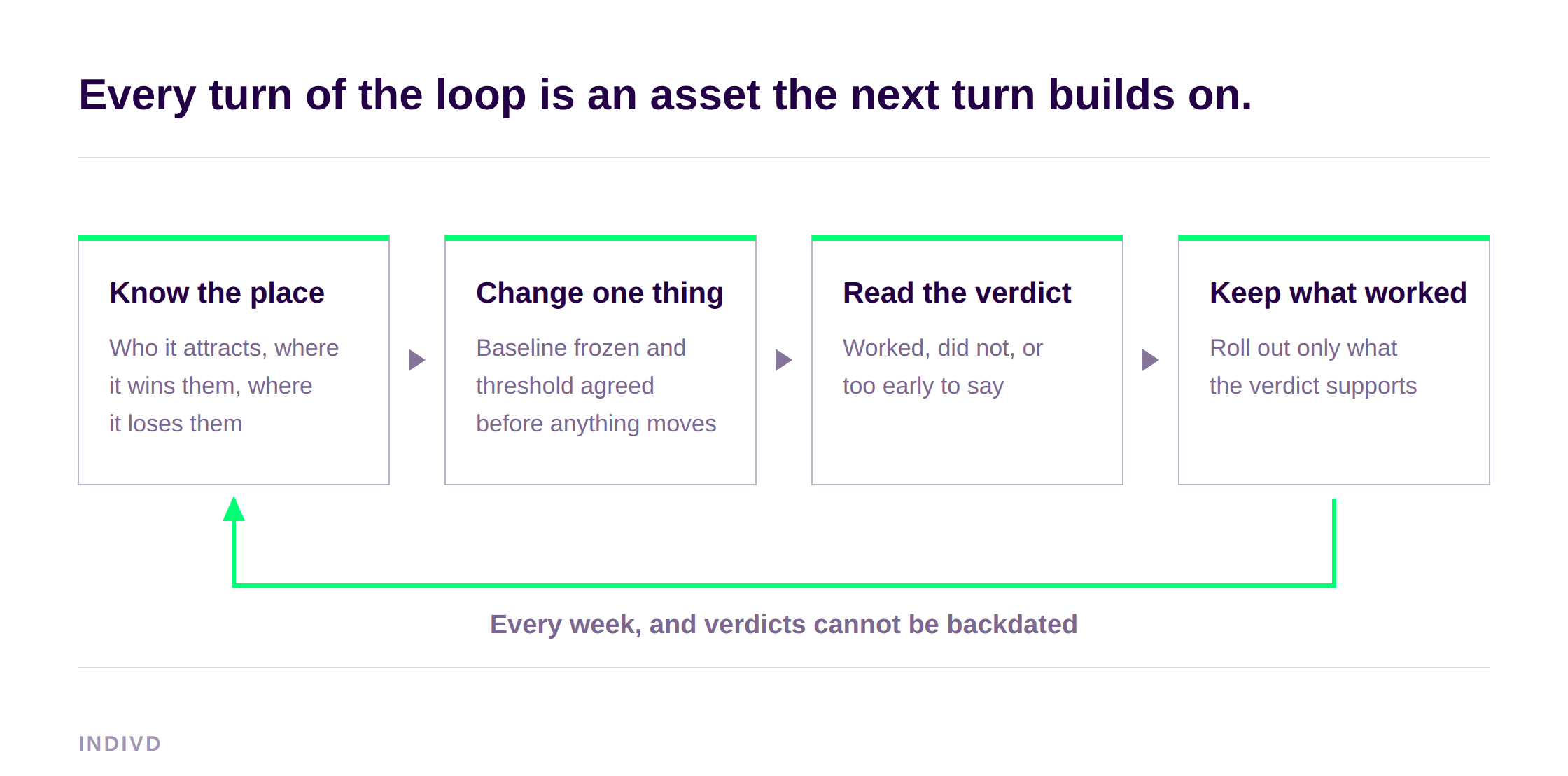
McKinsey's recommendation points at the discipline that replaces this: simulate and optimize in-store operations before making physical changes (McKinsey, 2026). The measured version of that doctrine is simpler and older than any technology: agree what counts as working before the change, freeze the comparison period, make one change at a time where possible, and read the verdict afterwards, worked, didn't, or too early to say, before the change rolls out anywhere else.
What that looks like in practice, in one week. A fashion retailer sees a persistent drop between the sales floor and the fitting rooms on Saturdays. The proposed fix is a second fitting-room attendant and a rearranged queue. Before anything changes, the team agrees the test: the metric is the share of floor visitors who reach a fitting room on Saturdays, the baseline is the four Saturdays before the change, frozen, and the threshold for "worked" is agreed in writing. The change goes into three stores on Monday. The following Monday, the verdict is read against the frozen baseline: the share rose meaningfully in two stores, and the third shows movement too small to call, so the honest verdict there is too early to say, run another week. Two stores' worth of evidence now supports rolling the fix out; one store earns a second look before it spends anything more. Total apparatus required: a decision made in advance, a baseline nobody can move afterwards, and the discipline to accept the verdict, including no.
Notice also what the fix was not. It was not a spectacle. The improvements that move a visit are usually this mundane, an attendant, a queue, a clearer product wall, because the visit's job is a decision, and the best experience a store can offer is the feeling of deciding easily. Theater has its place when it serves that job. When it does not, it is cost.
The improvements that move a visit are usually this mundane, an attendant, a queue, a clearer product wall, because the visit's job is a decision, and the best experience a store can offer is the feeling of deciding easily.
The compounding effect of this practice is easy to underestimate. A single verified answer is worth little. A hundred of them, accumulated across an estate, are an asset no competitor can buy, because verdicts cannot be backdated. This is where the research on technology leaders becomes concrete: IHL's 2026 study of more than 400 retail brands, pointedly titled The Compounding Retail AI Advantage, finds the gaps between leaders and the rest widening year over year, with leaders showing 99% higher profitability gains, and notes that fewer than 30% of retail AI projects make it past pilot (IHL Group, 2026). The leaders are not smarter. They are further along a loop the others have not started, and the loop is made of answered changes.
Every week smarter
The third capability is cadence. Knowledge that arrives quarterly arrives as history; knowledge that arrives weekly arrives as an instruction. The winning practice is a fixed weekly rhythm: what changed, what the change did, what to do next, per store.
Week 30 of that rhythm knows what week 1 could not see, and, notably, the leaders are not using this to shrink their teams: IHL finds technology leaders hiring store associates at nearly double the rate of everyone else (IHL Group, 2026). The record does not replace judgment. It feeds it.
TAKEAWAY
Every store known: who it attracts, where it wins them, where it loses them, per store, per week. Every change answered: worked, didn't, or too early to say, before it rolls out anywhere else. Every week smarter: what you learn accumulates, and it cannot be backdated.
The same playbook, in the other two rooms
Nothing in the three capabilities is retail-specific; only the vocabulary changes. In a shopping centre, every store known becomes every wing known: which tenants feed traffic to which, where visitors enter and never reach, what the last remix of the tenant mix actually did, so that every renewal and every valuation is argued on the landlord's own record of the visit rather than on the tenant's reports. In an airport, the unit is the terminal and the ratio is spend per passenger: every layout change and every concession tender answered in the airport's own record of the walk between security and the gate, instead of in the concessionaire's reported sales. The capability is identical in all three rooms: know the place, answer the change, accumulate the verdicts. Only the names of the zones differ.
Where to start
Not with technology, and not everywhere at once. Start with the questions. A leadership team can score itself in one meeting: Could you say what share of yesterday's visitors you were built for? Could you name your biggest drop inside the store, and where it happens? Could you say what a browsing visit was worth? Could your floor plan defend itself? Do your changes get verdicts, or reviews? Does week 30 in your estate know more than week 1 did? A shopping centre can score itself wing by wing, an airport terminal by terminal; the questions do not change.
Most estates today answer none of these, and that is the honest baseline of the visitation economy, not a verdict on anyone's competence. The instruments these industries own were built for a different job, and they still do that job well. But the visit became the product twenty years ago, the profit pools are following the operators who measure it, and the record that decides the next decade starts on the day a retailer starts writing it. Every month before that is data no one can ever recover.
ACADEMIC SOURCES
CSC and McKinsey & Company, "Shopping in the age of AI: Redefining stores for a new era", 27 April 2026. Survey of 3,004 US consumers with industry-leader interviews. Link
IHL Group, "The Pilot Phase is Over: The Compounding Retail AI Advantage", 16 February 2026. Analyst commentary. Source of the compounding characterisation. Link
IHL Group, "How Retail Leaders Outperform: What We Learned from 400+ Brands", part of the 2026 Retail Transformation Study, fielded autumn 2025.
Related reading
What is the visitation economy?
The Visitation Economy: When the visit is the product
Winners and losers in the visitation economy