
Indivd
•
•
Intro
An airport duty-free store achieved +97.25% absolute people counting accuracy across 107 lines, 27 cameras, 2,914 visitors, and 108 verified hours.
A duty-free store at an international airport in the Middle East had its complete selected counting set verified on 30 November 2025.
The verification covered 107 counting lines on 27 cameras, including store entrances, retail categories, till queues, corridors, specialist areas, and a display zone sold to brand partners.
Across 108 hours and 2,914 visitors, Indivd’s count was compared with an independent count of the same hours. The store achieved 97.25% absolute accuracy.
A weekday in late November inside an international airport duty-free store. Passengers arrive in waves shaped by the departure board.
They move past liquor shelves and confectionery, through display zones sold to brand partners, and into till queues that can remain stationary across a counting line.
The operator selected the hours and the scope. All 107 counting lines were assessed together.
The store
The traffic a brand pays for, measured at its own crossings
The store’s counting lines form a map of its commercial floor.
Liquor, tobacco, food, and confectionery are each measured at their own boundaries. These boundaries are open, so visitors can enter, turn, and cross the same line again within a short period.
Four till banks are measured using lines in both directions. This is where movement through the store becomes a purchase.
Corridors and routes to the dining offer measure circulation between the areas that generate revenue. A concept store and a specialist sales room are measured at their boundaries. Two main entrance lines and two main exit lines provide the visitor count beneath the store’s performance measures.
Eight crossings serve a different commercial purpose. They measure a display zone sold to brand partners.
A partner buying a display zone is buying access to the traffic around it. The count is the evidence of what that zone received.
Without an accurate count, the operator cannot reliably assess what a display delivered, whether a category earned its floor space, or how many passengers moved from the wider store into a specific commercial area.
Accuracy is not something a model has. It is something a deployment produces.
The check
The complete set of 107 lines was assessed together
The operator decided where, when, and how much was tested.
Across 108 hours, 2,914 visitors were included in the comparison. Indivd’s count was compared with an independent count of the same hours.
The verification covered:
• 107 counting lines
• 27 cameras
• 2,914 visitors
• 108 hours
• 8 display-zone crossings
The complete selected counting set was assessed together rather than limiting the check to particular entrances or easier counting points.
The store achieved 97.25% absolute accuracy.
Every counting error was included. A missed entry, a missed exit, and a person counted even though they did not cross were each recorded as errors. Errors in opposite directions were not allowed to cancel one another.
DEFINITION
Absolute accuracy is 100% minus the absolute error rate.
Undercounts and overcounts are both errors. A missed entry, a missed exit, and a counted person who never crossed are each counted in full. Errors in opposite directions cannot cancel one another.
The customer decides where, when, and how much is tested, can run the check without Indivd present, and can put the same test in anyone else’s hands.
What the number carries
One accuracy result across very different types of movement
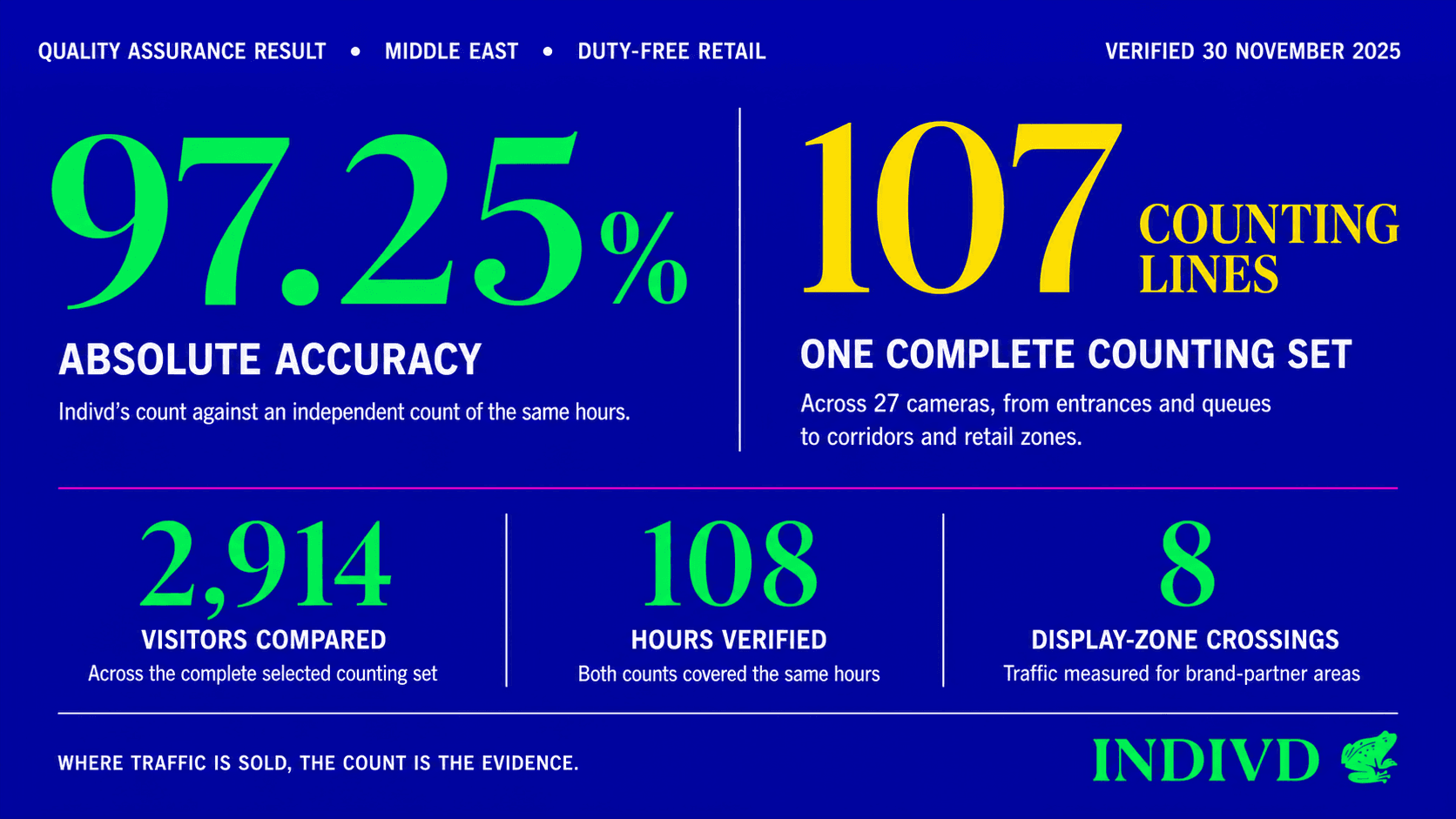
Verified on 30 November 2025: a duty-free store at an international airport in the Middle East achieved 97.25% absolute people counting accuracy against an independent count of the same hours.
The verification covered 2,914 visitors and 108 hours across 107 counting lines on 27 cameras.
Those lines measured different types of movement. They included entrances and exits, open category boundaries, bidirectional till queues, corridors, specialist areas, and a display zone sold to brand partners.
A stationary till queue behaves differently from a corridor. A visitor passing close to an open boundary can be difficult to distinguish from someone entering the zone. A result across counting points this varied reflects how the complete system was deployed and configured for the store.
For the operator, the value is the ability to use movement data commercially.
A brand partner can be shown the traffic measured at the eight display-zone crossings. The operator can assess whether passengers moved from the wider store into the zone and compare that movement with what the partner was sold.
An overcount could credit a display zone with traffic it did not receive. An undercount could make a category appear less effective and influence decisions about floor space, placement, and commercial partnerships.
When the complete counting set is verified, those decisions are more likely to reflect passenger behaviour rather than differences in measurement.
In a separate engagement, KPMG audited Indivd’s counting accuracy at a major retailer’s store against manual ground truth. Every camera tested came within 1.17%, the strongest result of any system included in that audit.
The next question is not simply how many passengers entered the store. It is how much of the traffic credited to a display zone actually crossed into it.
FAQ
What is capture rate in retail?
Capture rate is the share of people passing a store who come inside. It requires two counts, one at the entrance and one measuring pass-by traffic outside, and it separates a quiet period outside from a period when many passed and few entered.
How do airports measure passenger flow in duty-free stores?
By placing counting lines at entrances, category boundaries, till banks, corridors and specialist areas, then measuring crossings at each. This store's complete set of 107 counting lines on 27 cameras reached 97.25% absolute accuracy.
How do you measure the traffic delivered to a brand's in-store display?
By counting crossings at the display zone's own boundaries rather than inferring them from store entries. Eight counting lines here measured a zone sold to brand partners, which gives the operator evidence of what the partner actually received.
Can retail media be sold on measured store traffic?
Only if the measurement can be shown. A count verified at the zone's own boundaries is the evidence a brand partner can be given, and the basis on which the space can be priced.
How accurate is people counting in airport retail?
Arrival surges, luggage, passengers moving at speed and open frontages with no doorway make travel retail one of the hardest formats to count. This verified duty-free store reached 97.25% absolute accuracy across all 107 counting lines, covering 2,914 visitors over 108 hours.
Can a third party verify Indivd's counting accuracy?
Yes. The customer decides where, when, and how much is tested, can run the check without Indivd present, and can put the same test in anyone else's hands.