
Indivd
•
•
Intro
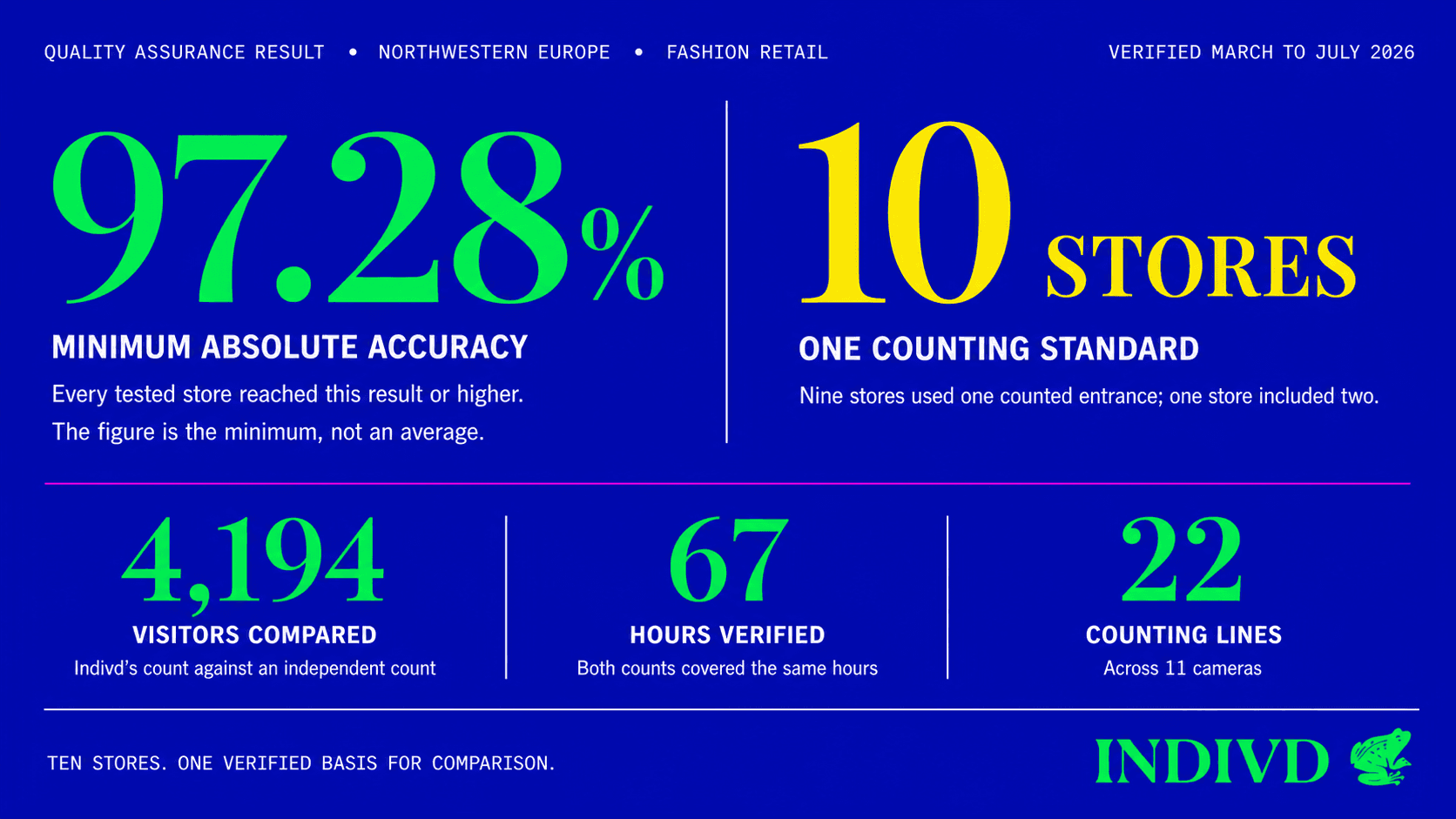
A fashion retailer in Northwestern Europe achieved at least 97.28% absolute counting accuracy in each of its ten stores. The check covered 4,194 visitors, 67 hours, 22 counting lines and 11 cameras.
A fashion retailer in Northwestern Europe had its people count verified at ten stores between March and July 2026.
At every location, Indivd’s count was compared with an independent count of the same hours. Each store achieved at least 97.28% absolute accuracy.
This is the lowest result among the ten stores, not their average. The verification covered 4,194 visitors and 67 hours across 22 counting lines on 11 cameras.
Ten fashion stores in Northwestern Europe, from spring into summer. At nine locations, the selected count used one entrance line and one exit line at one counted entrance. The tenth location included a second counted entrance. The retailer selected the verification periods at every store.
The stores
One visitor count beneath every store comparison
At nine of the ten stores, one pair of lines produced the complete visitor count included in the verification. Whatever those lines missed, the selected store count also missed.
Fashion entrances can be difficult places to measure. Groups arrive together and leave separately. Window shoppers pause near the threshold without entering. Seasonal clothing changes how people appear to a camera.
The resulting visitor count supports conversion analysis, staffing decisions, and assessments of window displays and collection launches.
An accurate count helps a store distinguish between two very different problems: a week that attracted fewer visitors and a week that converted fewer of the visitors who arrived.
Across a retail chain, the stakes are higher. Stores are compared with one another, and each comparison assumes that their visitor counts are equally reliable.
If the counts differ in accuracy, a performance table can interpret measurement differences as trading differences.
Accuracy is not something a model has. It is something a deployment produces. This retailer had ten deployments assessed across ten stores.
The check
Ten stores assessed using one standard
The retailer decided where, when, and how much was tested at each store between March and July 2026.
Across the ten locations, 4,194 visitors were included in the comparison over 67 hours. Indivd’s count was compared with an independent count of the same hours.
The verification covered:
• 10 fashion stores
• 4,194 visitors
• 67 hours
• 22 counting lines
• 11 cameras
Each store’s complete selected counting set was assessed together.
Every store achieved at least 97.28% absolute accuracy. This figure is the lowest result among the ten locations.
Reporting the minimum matters because it states the accuracy achieved at every tested store. An average could allow stronger results at some locations to conceal a weaker result elsewhere.
Every counting error was included. A missed entry, a missed exit, and a person counted even though they did not cross were each recorded as errors. Errors in opposite directions were not allowed to cancel one another.
DEFINITION
Absolute accuracy is 100% minus the absolute error rate.
Undercounts and overcounts are both errors. A missed entry, a missed exit, and a counted person who never crossed are each counted in full. Errors in opposite directions cannot cancel one another.
The customer decides where, when, and how much is tested, can run the check without Indivd present, and can put the same test in anyone else’s hands.
What the number carries
One verified basis for comparing ten stores
Verified between March and July 2026: every one of ten fashion stores in Northwestern Europe achieved at least 97.28% absolute people counting accuracy.
The verification covered 4,194 visitors and 67 hours across 22 counting lines on 11 cameras.
The minimum result was 97.28%, which means every tested store achieved that level of accuracy or higher.
For the retailer, the value is one measurement standard beneath ten store counts. Store-to-store comparisons are more dependable when each visitor count has been assessed using the same accuracy measure.
Staffing decisions, conversion rates, entry-rate changes, and early reads of a new collection all depend on those counts.
Without verification, an error at one location can quietly change the ranking of the retail estate. An undercount can make a successful store appear to have attracted fewer visitors. An overcount can make conversion appear weaker and create a performance problem that does not exist.
When the ten counts are assessed in the same way, differences in performance are more likely to reflect the stores rather than their counting systems.
In a separate engagement, KPMG audited Indivd’s counting accuracy at a major retailer’s store against manual ground truth. Every camera tested came within 1.17%, the strongest result of any system included in that audit.
The retailer can now ask which of the ten stores converts its visitors most effectively, based on counts assessed using one standard.
FAQ
What is retail footfall analytics?
Retail footfall analytics turns visitor counts into measures a store can act on: conversion, sales per visitor, traffic by hour, and comparisons between locations. Every one of those measures inherits the accuracy of the count underneath it.
How do multi-store retailers benchmark store performance?
By comparing ratios rather than totals, and by making sure every denominator in those ratios was verified the same way. Across ten verified fashion stores, every location reached at least 97.28% absolute accuracy on 22 counting lines.
Why do identical people counters give different results in different stores?
Because accuracy is produced by a deployment, not held by a model. Entrance width, ceiling height, how groups arrive, what people carry, and how light falls all change what a counting line sees.
How does footfall accuracy affect store rankings?
A performance table has no column for counting error, so a store undercounted more than its neighbours appears to convert better than it does. The ranking then rewards the counter rather than the store.
What data do you need to compare stores fairly?
A visitor count for each store that has been assessed against an independent reference using the same error measure. Without that, differences in the table can come from measurement rather than from trading.
Can a third party verify Indivd's counting accuracy?
Yes. The customer decides where, when, and how much is tested, can run the check without Indivd present, and can put the same test in anyone else's hands.