
Indivd
•
•
Intro
Retail, food and parking are roughly 37 percent of airport income. Spend per passenger moves every quarter, and nothing the airport owns says why.
The industry's defining ratio moves every quarter, and nothing the airport owns can say why.
The airport is the visitation economy in its purest form. The flight is compulsory and the walk is not: an airline sells the seat, and an airport sells access to the passenger. Everything an airport earns commercially happens in the part nobody has to do, which is why retail, food and parking made up roughly 37 percent of airport income worldwide in 2023, $54 billion of $146 billion across more than a thousand airports (ACI World, 2025), much of it earned as a share of concession sales above a minimum annual guarantee. Every visitor is identified, dwell is framed by the departure board, and visitors are worth wildly different amounts by route, nationality and journey type. The airport's scoreboard is spend per passenger: one ratio, no composition.
Nobody has to come anymore. Every visit is chosen, and every visitor is worth something different.
Read the full definition.
The scoreboard broke first here
Airports saw the visit decouple from the money before anyone else, and in public. In 2024, global passenger traffic passed 2019 by 4 percent, while non-aeronautical revenues remained 9 percent below it; ACI's own summary is that passenger demand has fully rebounded while airport revenues are still catching up (ACI World, 2026). Per passenger, global non-aeronautical revenue declined from $8.61 in 2017 to $7.57 in 2024 (ACI World, 2026). The number at the door stopped predicting the money, and the airport's paradox makes it sharper than anywhere else: boarding data documents precisely who flew, down to the seat, while almost nothing documents the visit between security and the gate. The best-documented visitors in any industry, and the least-documented visits.
The best-documented visitors in any industry, and the least-documented visits.
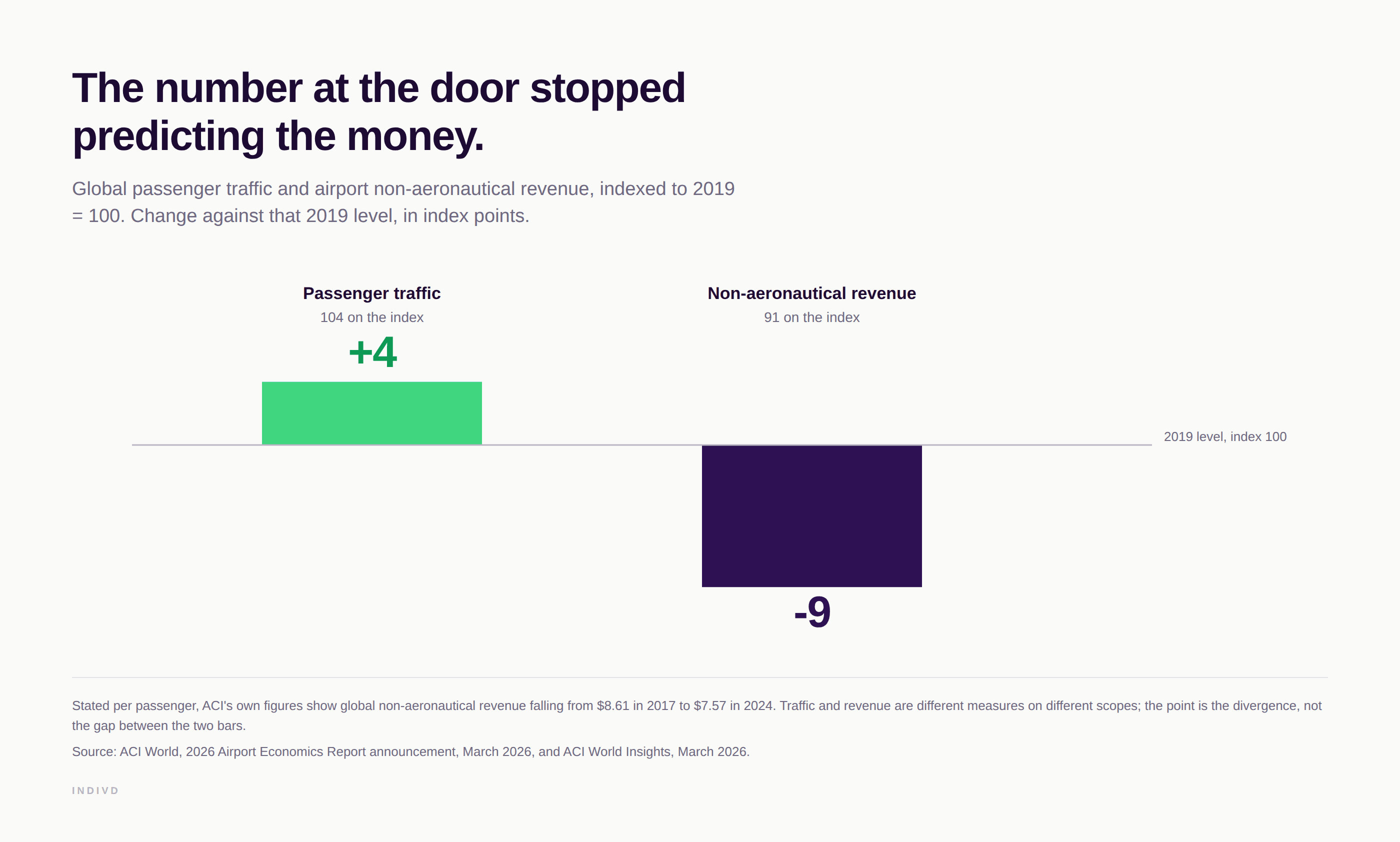
The airport's divide
The decoupling is not uniform, and the spread between operators is the industry's own winners-and-losers chart. Paris's airside spend per passenger rose from €23.5 in 2019, restated like for like, to €31.7 in 2025 (Groupe ADP annual results). Aena's commercial revenue per passenger rose from €4.51 in 2019 to €5.72 in 2024 (Aena results presentations). Frankfurt's net retail revenue per passenger was €3.28 in 2019 and €3.29 in 2025 (Fraport annual reports). The three ratios are defined differently, so each should be compared only with its own past, and the comparison inside each one tells the same story: the operators that re-engineered the commercial model around the visit grew a third above 2019, while the operators riding the old curve went flat in nominal terms, which is a decline in real ones. The divide is not between airports with and without passengers. It is between airports that manage the visit and airports that count it.
What winning looks like in an airport
Every euro of spend per passenger explained.
Every layout and every tender answered in SPP.
Every concession negotiated on a record of the visit only the airport owns.
The airport that holds that record can say why its defining ratio moved, test a layout change against its own reference before rolling it through a terminal, and bring its own evidence to the minimum annual guarantee, the act that runs today on the concessionaire's reported sales. The record starts the day it starts. The months before it can never be measured again.
ACADEMIC SOURCES
ACI World, 2025 Airport Economics Report announcement, April 2025. Global airport revenues of $146 billion in 2023, of which non-aeronautical revenues were 54 billion, 36.7 percent, across 1,060 airports.
ACI World, 2026 Airport Economics Report announcement, March 2026. In 2024, traffic 4 percent above 2019 while non-aeronautical revenues remained 9 percent below.
ACI World Insights, March 2026. Non-aeronautical revenue per passenger, $8.61 in 2017 to $7.57 in 2024.
Groupe ADP, full-year results. Extime Paris sales per passenger, airside spend divided by departing passengers, €23.5 in 2019 restated like for like to €31.7 in 2025.
Aena, results presentations. Commercial revenue per passenger, €4.51 in 2019 to €5.72 in 2024.
Fraport, annual reports. Net retail revenue per passenger at Frankfurt, €3.28 in 2019 and €3.29 in 2025.