
Indivd
•
•
Intro
A centre's income is increasingly tied, by contract, to what happens on a floor it can count but cannot explain.
A shopping centre never owned a till. Its product has always been the visit: the landlord attracts visitors and distributes them across a floor of tenants who pay for access to them. That makes the centre the most natural resident of the visitation economy, and the one whose contracts arrived there first.
Nobody has to come anymore. Every visit is chosen, and every visitor is worth something different.
Read the full definition.
The rent moved onto the visit
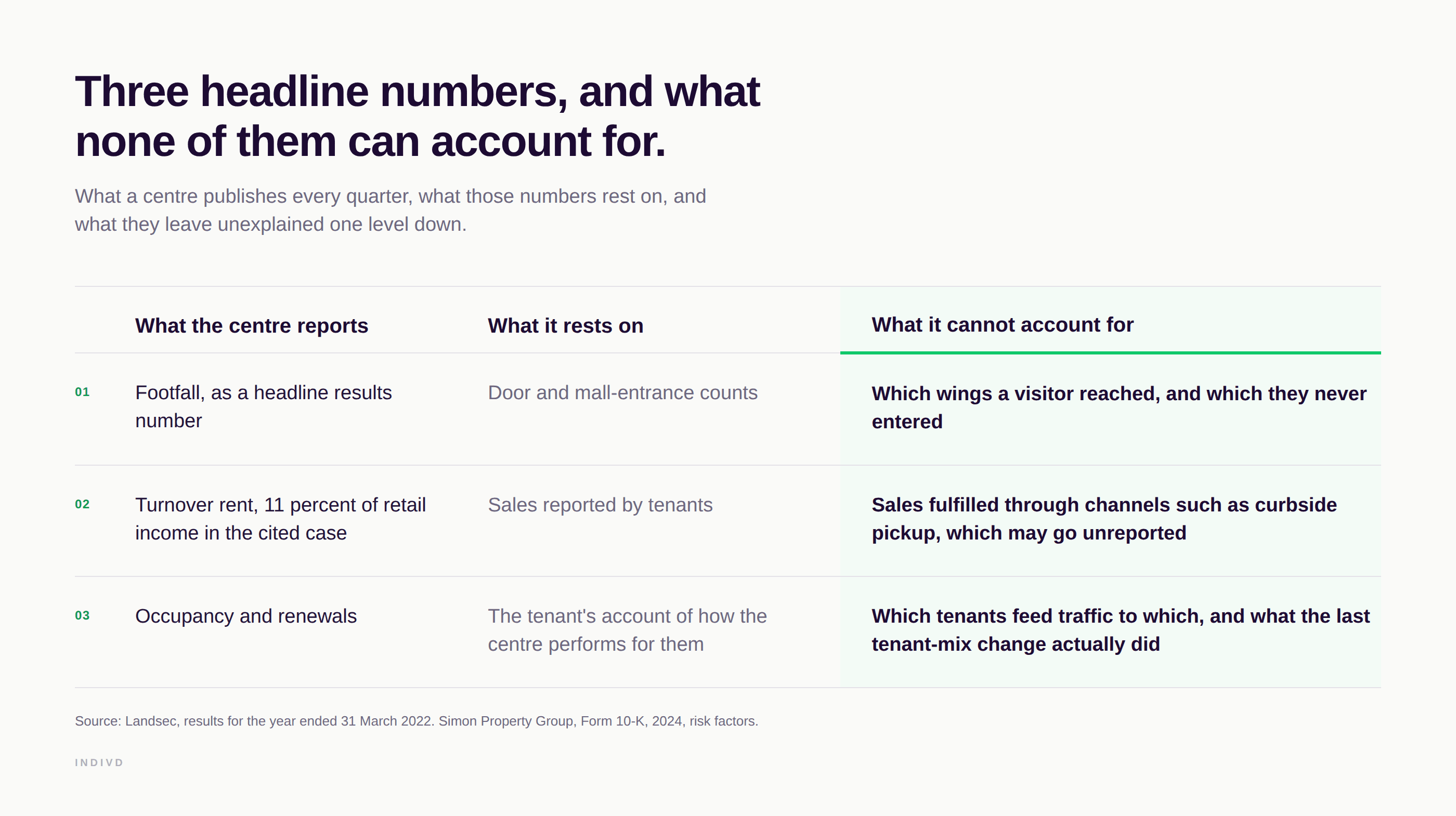
The lease model itself is shifting towards the visit. Landsec, reporting on its UK retail destinations for the year to March 2022, stated that around 30 percent of its leases carry a turnover element and that turnover rent makes up 11 percent of its retail income. Unibail-Rodamco-Westfield disclosed sales-based rents of €123.6 million in 2022, 6.1 percent of net rental income. And the income that depends on tenant-reported sales rests on reporting the landlord does not independently produce: Simon Property Group tells the SEC, in its 2024 Form 10-K risk factors, that overage rent depends on reported sales and that sales fulfilled through channels such as curbside pickup may go unreported. A growing share of the centre's revenue is contractually tied to a floor it does not have its own complete record of.
Meanwhile the visit is already one of the industry's headline numbers. URW reported footfall up 1.9 percent in 2025 as support for tenant sales; Klépierre reported footfall up 1.8 percent; Hammerson includes visitor numbers in the headlines of its results. The centre reports the visit to the market every quarter, and cannot explain it one level down: which tenants feed traffic to which, which share of visitors ever reaches a wing, what the last remix of the tenant mix actually did.
The centre reports the visit to the market every quarter, and cannot explain it one level down.
The centre's divide
No segment shows the visitation economy's divide more brutally. Since 2005, the bottom quartile of UK shopping centres has lost 91 percent of its capital value, while the top quartile lost 12 percent, on Knight Frank's analysis of MSCI index data. The winning end compounds: Klépierre closed 2025 at 97.1 percent occupancy with retailer sales up 3.4 percent, double the national retail sales indices in its markets, and URW cut vacancy to 4.6 percent in 2025, its lowest since 2017. The same asset class, the same two decades, and one end lost nine tenths of its value. Valuation practice is following the visit too: RICS describes valuers weighting operational evidence such as footfall, and documents a 2024 transaction in which footfall thresholds were written into the lease with tenant break rights attached.
What winning looks like in a centre
Every wing's traffic owned.
Every remix answered in tenant sales and NRI.
Every renewal and every valuation argued on the landlord's own record of the visit.
The centre that holds that record negotiates renewals using its own evidence rather than relying solely on tenant reports. It gives every tenant-mix decision a verdict instead of a forecast, and walks into every valuation with the operational record valuers increasingly ask for. The record starts the day it starts. The months before it can never be measured again.
ACADEMIC SOURCES
Landsec, results for the year ended 31 March 2022. Around 30 percent of leases carried a turnover element; turnover rent 11 percent of retail income.
Unibail-Rodamco-Westfield, FY 2022 results. Sales-based rents of €123.6 million, 6.1 percent of net rental income. FY 2025 results: footfall up 1.9 percent, vacancy 4.6 percent, its lowest since 2017.
Simon Property Group, Form 10-K, FY 2024. Risk factors on overage rent and sales that may go unreported through certain fulfilment channels.
Klépierre, FY 2025 earnings, February 2026. Occupancy 97.1 percent, like-for-like retailer sales up 3.4 percent, footfall up 1.8 percent.
Hammerson, FY 2024 results.
Knight Frank, "The Retail Note: Shopping centres, where did it all go wrong?", June 2024. Knight Frank analysis of MSCI index data.
RICS Property Journal, June 2024. Footfall in valuation practice and in lease terms.