
Indivd
•
•
Intro
Nobody has to come anymore. What that changed for stores, shopping centres and airports, and what it takes to win in any of them.
A visit used to be something no place had to earn. Stores, shopping centres and airports were all built in that world. Demand arrived on its own, the visit was free, and nearly everyone who mattered ended up paying: at the till, through the tenant's reported sales, at the concession counter. So all three places measured the buying, and each had the right scoreboard for it: sales per square metre, rent per square metre, spend per passenger. Call that world the transaction economy. In 2000, e-commerce was around one percent of retail (US Census Bureau); the buying had nowhere else to go, so measuring the buying meant measuring the place.
THE SHIFT
The transaction economy has ended, and we have a name for what replaced it: the visitation economy.
Nobody has to come anymore. Every visit is chosen, and every visitor is worth something different.
Consider what actually changed, starting in the room where it is easiest to see. Online now accounts for around one in five retail purchases across Europe's five largest markets, and Forrester expects that share to reach 22 percent by 2028. The customer holds the whole assortment in their pocket. When they still choose to travel to a store, they come for the things a screen cannot do: to see, to try, to compare, to decide. The store's job widened from completing transactions to hosting decisions, and the money those decisions produce often lands somewhere else entirely: online, later, in another channel.
RESEARCH GROUNDING
Peer-reviewed research has measured this directly: when an online-first eyewear retailer opened physical showrooms, total sales in each showroom's trading area rose by an average of 7.4 percent, and web sales rose 2.9 percent alongside them (Bell, Gallino and Moreno, 2018). The store was producing revenue its own ledger never recorded.
Is this simply the familiar story of e-commerce eating physical retail? Are these places in decline? Should their owners accept that the buying records tell them less every year?
The answer to the first two questions is no, and to the third, only if they choose to. Roughly four in five retail transactions still happen in physical stores. The store is not shrinking; its job is widening, and the industry's own advisors have already said so. McKinsey now recommends that retailers assign each location a defined mission, such as a discovery flagship or a convenience hub, and design layout, assortment and staffing around that mission (McKinsey, 2026). Deloitte states it plainly: the modern store is no longer just a point of sale (Deloitte, 2025). What it is becoming is the point of decision. The consensus is settled. These places have a new job, and the two worlds can be laid side by side.
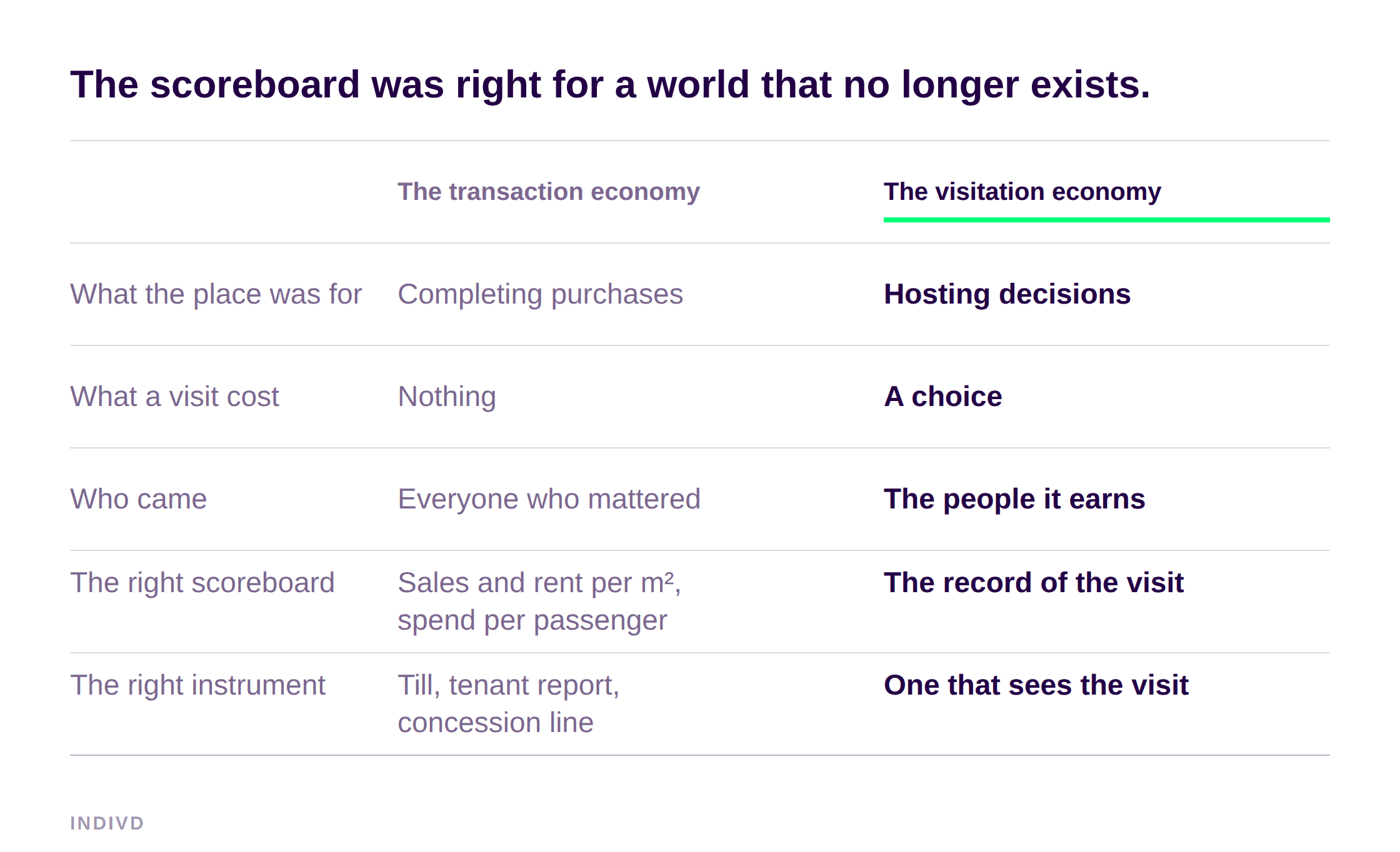
One caution before going further, because the industry already has a word for the store's new job, and the word misleads. Experience has come to mean theater: the climbing wall, the coffee bar, the store as entertainment. Every retail leadership team has seen the bad version, and most have a private name for it. Hosting decisions is a different and more commercial job. A visit succeeds when someone got to see the product in real life, hold it, compare two of them, ask someone who knows, and leave closer to a decision. By that standard, a clear product wall and a present, knowledgeable member of staff are a better experience than most spectacles, and a store can be spectacular and still fail its visitors completely. In the visitation economy, experience is whatever helps the visit do its job. The job is the decision.
The job changed. The measurement did not.
The shift is easiest to watch inside a store, so picture a Saturday afternoon in a mid-sized fashion store. A woman in her thirties walks in from the high street, drawn by the window. She crosses the floor, spends four minutes in womenswear, picks up two jackets, carries one to the fitting room, and joins a queue of five. After three minutes she checks her watch, hangs the jacket on the rail by the queue, and leaves. At nine that evening she buys the same jacket from the retailer's own site, on her sofa.
Now audit what the store's instruments recorded. The counter logged one visitor, indistinguishable from the tourist who wandered through to use the escalator. The till recorded nothing; she bought nothing there. The loyalty system recorded nothing; she never reached a checkout to scan. The e-commerce platform booked the sale and credited it to the website. The store did almost everything, the attraction, the trial, the decision, and the ledger awarded it a zero. Multiply her by every Saturday, every store, and the size of the accounting error comes into view.
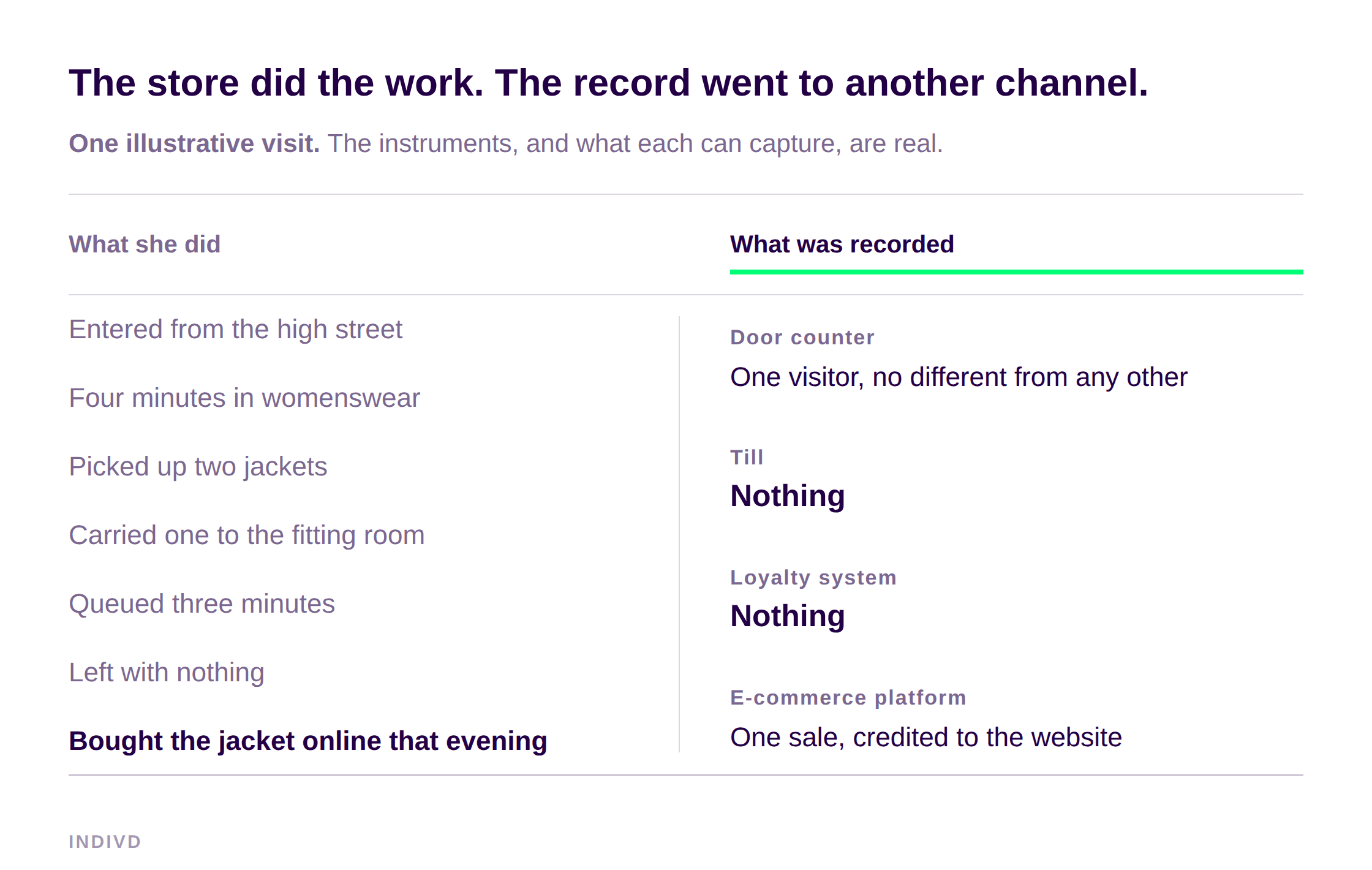
Here is the asymmetry that defines the visitation economy. The store's new job is everything before the buying: attract the right people, let them see, let them try, help them decide. Yet nearly every instrument a retailer owns still watches the last step. The till records what sold, never to whom it almost sold. The counter records how many came in, and counts every visitor as the same. The loyalty card records members, at the moment they buy. A number at the door, a receipt at the till, and nothing in between.
This is not a criticism of retailers. The till, the counter and the loyalty card are transaction-economy instruments: correct for the job that era gave them, and still excellent at it. The point is narrower and harder: the work that now decides a store's success, the visit itself, is performed daily in front of instruments built to ignore it.
One shift, three rooms
The store is only the clearest room to watch. The shift runs through the other two with more contractual force, not less.
The shopping centre never owned a till at all. Its product has always been the visit: a landlord attracts visitors and distributes them across a floor of tenants who pay for access to them. That link is now moving into the contracts themselves. Turnover rent ties a growing share of income to what happens on the floor, while the underlying sales record still comes from tenants. The centre reports footfall and tenant sales, but it cannot independently explain which wings generate traffic, which tenants feed one another or what a change in tenant mix actually achieved.
RESEARCH GROUNDING
Landsec, reporting on its UK retail destinations for the year to March 2022, stated that around 30 percent of its leases carry a turnover element and that turnover rent makes up 11 percent of its retail income (Landsec, 2022). Europe's largest listed landlords already report footfall as a headline number in their results; Unibail-Rodamco-Westfield reported footfall up 1.9 percent in 2025 as support for tenant sales (URW, 2026). A growing share of the centre's income is contractually tied to what happens on a floor it can count but cannot explain.
The airport is the visitation economy in its purest form. Retail, food and parking make up roughly 37 percent of airport income worldwide (ACI World, 2025), much of it earned as a share of concession sales, and the industry's scoreboard is spend per passenger. That scoreboard has already broken with the old world: in 2024, global passenger traffic passed 2019 by 4 percent while non-aeronautical revenues remained 9 percent below it (ACI World, 2026). And the airport's version of the asymmetry is the sharpest of the three: it knows precisely who flew, because boarding data is documented to the seat, and it knows almost nothing about the visit between security and the gate. The best-documented visitors in any industry, and the least-documented visits.
Three rooms, one condition. Nobody has to come to any of them anymore, every visitor is worth something different in all of them, and none of the instruments they run on records the visit that has become their product.
DEFINITION
Nobody has to come anymore. Every visit is chosen, and every visitor is worth something different. Formally: the visitation economy is the market condition in which the visit itself is the product and visitors carry unequal value, so the record of visits, who came, what they did, and what changed their behaviour, becomes the most decisive asset of any place built on visits, a store, a shopping centre, an airport, because it is the only record of that place's actual work.
What winning looks like
Winning the visitation economy is not a technology project. It is a change in what an operator chooses to know. The operators pulling ahead can answer questions no buying record can: not how many came, but who; not what sold, but where the visit was won or lost; not whether revenue moved after a change, but whether the change caused it. Those answers are the subject of the two companion pieces to this article: the evidence that the market is already dividing on this line, and the operating practices of the retailers on the winning side of it.
What should a leadership team ask itself now? Four questions. Could you say what share of yesterday's visitors you were built for? Could you name your biggest drop inside the store, and where it happens? Could you say what a browsing visit was worth? Could your floor plan defend itself? The questions translate without loss: a shopping centre asks them wing by wing, an airport terminal by terminal.
If those questions have no answers today, that is not a failure. It is the starting condition of the visitation economy, shared by nearly every store, centre and airport. What separates the winners is that they stopped accepting it. The visit became the product twenty years ago. The time to start recording it is now.
ACADEMIC SOURCES
US Census Bureau, E-Stats, "E-commerce 2000" (2002). Retail e-sales were 0.9% of total retail sales in 2000. Link
Forrester, "Europe-5 Online Retail Forecast, 2023 To 2028", press release, December 2023. Online reaching 22% of total retail in France, Germany, Italy, Spain and the UK by 2028, from 16% in 2023.
Bell, D.R., Gallino, S., Moreno, A. (2018). "Offline Showrooms in Omnichannel Retail: Demand and Operational Benefits." Management Science, 64(4), 1629-1651. DOI 10.1287/mnsc.2016.2684.
ICSC and McKinsey & Company, "Shopping in the age of AI: Redefining stores for a new era", 27 April 2026. Survey of 3,004 US consumers with industry-leader interviews. Link
Adam York, "Future-proof your stores", Deloitte, 19 November 2025. Link
Landsec, results for the year ended 31 March 2022. Around 30% of leases with a turnover element; turnover rent 11% of retail income. Link
Unibail-Rodamco-Westfield, FY 2025 earnings, February 2026. Footfall up 1.9%, framed as supporting positive tenant sales evolution.
ACI World, 2025 Airport Economics Report announcement, April 2025. Global airport revenues of 146 billion US dollars in 2023, of which non-aeronautical revenues were 54 billion, 36.7 percent, across 1,060 airports. Link
ACI World, 2026 Airport Economics Report announcement, March 2026. In 2024, traffic 4% above 2019 while non-aeronautical revenues remained 9% below. Link
Common questions
What is the visitation economy?
The visitation economy describes a shift in how physical places create and measure value. When people can shop, work and access services without visiting in person, every physical visit becomes a choice. Stores, shopping centres and airports therefore need to understand not only what people buy, but why they visit, how they behave and what value the visit creates.
How is the visitation economy different from the transaction economy?
The transaction economy measures physical places primarily through what gets sold there. The visitation economy looks at the full value of the visit, including engagement, movement, intent and decisions that may lead to a transaction elsewhere or later. The transaction remains important, but it is no longer the complete measure of a place's performance.
Why does the visitation economy matter for physical locations?
Traditional metrics such as sales and footfall show outcomes, but reveal little about what happens between entering and buying. Understanding the visit helps physical locations see which visitors engage, where interest is created or lost, how spaces perform and which changes improve the visitor experience and commercial results.
How can businesses measure the value of a visit?
By connecting footfall with behavioural signals across the physical journey. Depending on the location, this can include drop-in rate, visitor engagement, zone visits, fitting-room use, return visits and conversion. Together, these signals create a record of the visit rather than relying on the transaction alone.